


Are you ready to take your business to the next level with cutting-edge digital solutions? Look no further! At InnoSewa, we specialize in providing comprehensive digital services that streamline your IT operations, enhance your online presence, and drive growth.
Started in 2017, InnoSewa helps companies make the promise of digital transformation a reality. We work collaboratively with you to create a deep understanding of the risks and opportunities presented by new emerging technologies and think creatively about how you can use these technologies to improve business performance.
INNOSEWA INSIGHTS · CLOUD & DEVOPS
Infrastructure as CodeSmarter Infrastructure. Better Automation.
A practical guide to repeatable infrastructure, safer changes and a measured path to automation.
By InnoSewa Digital Services Pvt. Ltd. · Approx. 10-minute read
Infrastructure Automation for Growing Businesses
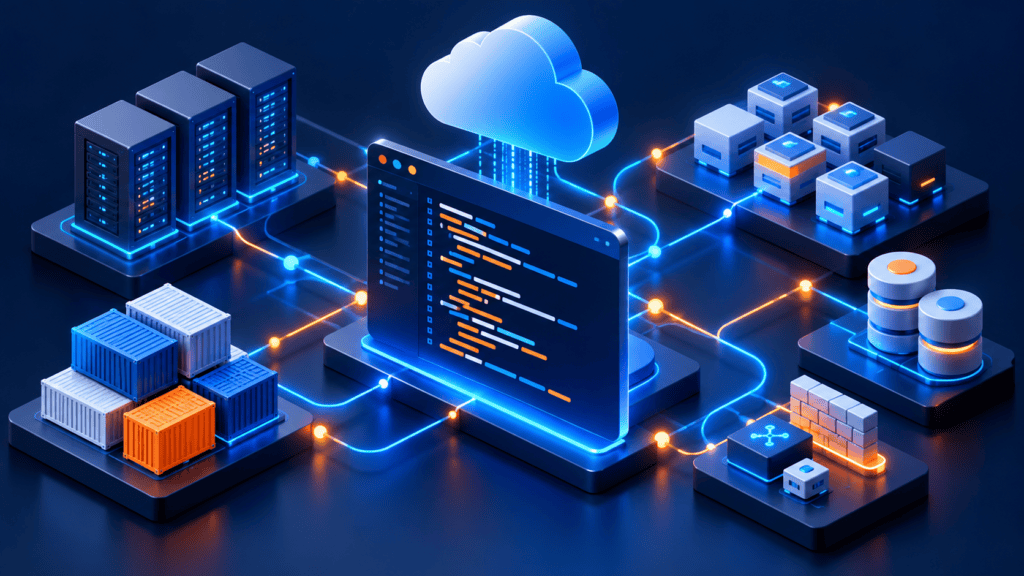
Growing businesses need infrastructure that can support reliable applications, changing demand and controlled releases. Manual setup becomes harder to sustain as the number of servers, environments and dependencies increases.
Infrastructure as Code brings those setup decisions into code. It helps teams automate repetitive work, review proposed changes and recreate infrastructure more consistently. This guide explains how it works, where it fits and how to adopt it responsibly.
What Is Infrastructure as Code?
Infrastructure as Code (IaC) is the practice of defining and managing infrastructure through machine-readable configuration files or programs. Instead of creating every server, network and database manually, teams describe the resources they need and use automation tools to provision them through provider APIs.
For a business application, that definition might include a virtual network, application servers, a load balancer, storage, database services and access rules. The code becomes a reviewable record of how the environment should be built. Storing it in version control helps teams understand who changed a setting, why it changed and which version was deployed.
IaC does not make infrastructure self-managing. Engineers still design the architecture, review changes, maintain tools and monitor the running systems. It gives those engineers a consistent way to turn approved decisions into repeatable deployments.
How Infrastructure Automation Works
The lifecycle begins with an infrastructure definition and continues after deployment. A dependable workflow separates authoring, validation, approval and execution so that a configuration change does not become a production change without review.
- Define: Describe resources, relationships and environment-specific inputs in code.
- Version and validate: Commit the change to Git, check syntax and evaluate security policies.
- Review the plan: Inspect proposed additions, modifications and deletions. Check the likely operational and cost impact.
- Apply approved changes: Provision through controlled automation with appropriate credentials.
- Monitor and reconcile: Detect drift and investigate differences between the declared configuration and deployed resources.
Some tools use a declarative model: teams specify the desired end state, and the tool determines the changes required. Configuration-management tools can complement provisioning tools by managing operating-system packages, application settings and routine operational tasks.
The Infrastructure Automation Lifecycle
01
DEFINE
Describe resources
02
REVIEW
Validate and approve
03
DEPLOY
Apply the approved plan
04
RECONCILE
Monitor and address drift
Each deployment returns to monitoring and review. This workflow supports ongoing change, rather than a one-time setup.
Key Benefits for Businesses
REPEATABILITY BY DESIGN
One definition.
Consistent environments.
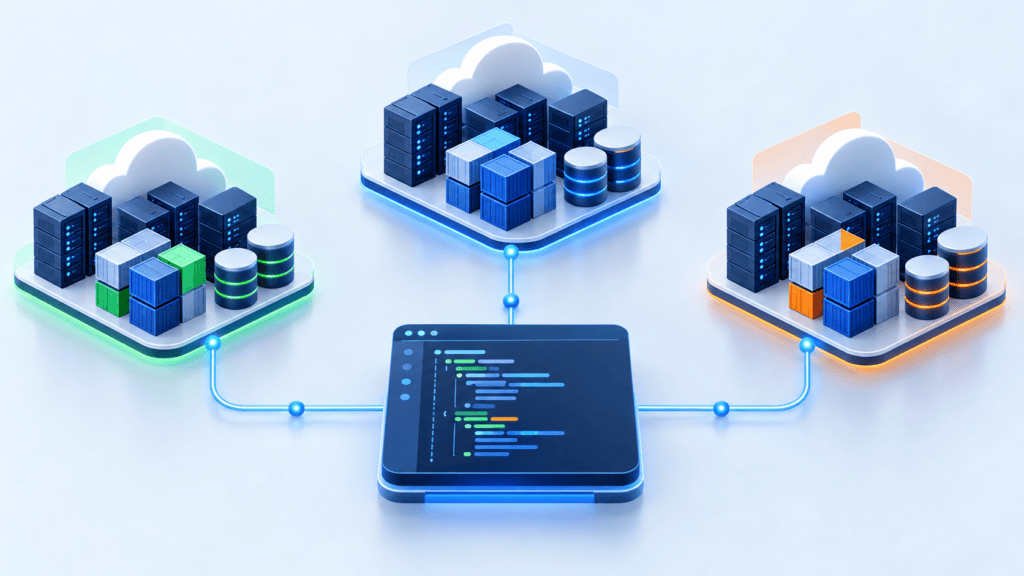
Reusable code helps teams standardize development, testing and production while keeping each environment’s settings explicit.
Faster, repeatable deployment
Reusable definitions reduce the time spent repeating setup tasks. Teams can create approved environments more quickly, although deployment time still depends on service availability, resource quotas, dependencies and internal approvals. The value comes from repeatability, rather than a universal promise that every environment will deploy in minutes.
Greater consistency
Shared modules help development, testing and production follow the same architectural patterns. Environment-specific parameters can vary without requiring teams to rebuild each environment independently. This reduces avoidable configuration differences that otherwise surface during release testing.
Clearer collaboration and accountability
Infrastructure changes can follow the same pull-request process as application code. Developers, operations specialists and security reviewers can assess a proposal together, with a history of the discussion and the deployed revision.
More controlled scaling and spending
Infrastructure automation makes it easier to replicate environments and add resources in a consistent way. It does not automatically configure autoscaling or guarantee savings. Cost control still requires suitable sizing, usage monitoring, budgets, tagging and cleanup of temporary resources.
Security checks earlier in delivery
Teams can validate access rules, encryption settings and other policies before deployment. Combined with least-privilege credentials and monitoring, this creates a more systematic security process. IaC supports compliance evidence; it does not establish regulatory compliance on its own.
Popular Infrastructure as Code Tools
Choose tools around the infrastructure you operate and the skills your team can maintain. A single company may use a provisioning tool alongside a configuration-management tool because their responsibilities differ.
| Tool | Typical role | Decision to consider |
|---|---|---|
| Terraform | Declarative provisioning using HCL and providers | Provider coverage, state management and team workflow |
| Ansible | Configuration management, deployment and operational automation | Host access, inventory and repeatable playbook design |
| AWS CloudFormation | Template-based provisioning of AWS resources | AWS-focused architecture and stack lifecycle |
| Pulumi | Infrastructure definitions using languages including Python, TypeScript, Go and C# | Language expertise, providers and deployment governance |
Evaluate these tools with a small representative workload. Check how each handles previews, imports, dependencies, secrets and recovery. Avoid choosing solely on a feature list: a tool your team can operate safely is more useful than one whose complexity exceeds your support capacity.
IaC vs. Traditional Infrastructure Management
| Aspect | Manual management | Infrastructure as Code |
|---|---|---|
| Provisioning | Individual console or command-line steps | Repeatable code-driven workflows |
| Change history | Depends on logs and documentation | Versioned definitions and code review |
| Consistency | Requires careful repeated configuration | Shared definitions and reusable modules |
| Recovery | Manual reconstruction may be required | Repeatable provisioning alongside data restoration |
| Risk | Local mistakes and undocumented changes | Automation can propagate mistakes at scale |
IaC improves how changes are made and reviewed, but it does not remove operational risk. A small incorrect rule in a shared module can affect several environments. Testing and controlled rollout remain essential.
Where Businesses Can Apply IaC
Cloud infrastructure and migration
IaC can define networking, compute, storage and access policies for a new cloud environment. During a migration, teams must also plan application dependencies, data movement, downtime and validation. Explore InnoSewa’s migration services when assessing the wider transition.
DevOps and application delivery
Infrastructure definitions can move through CI/CD pipelines with syntax checks, policy evaluation and deployment approval. This connects infrastructure readiness with application releases. For businesses building or modernizing applications, custom software development provides a natural context for planning these delivery workflows.
Temporary testing environments
Teams can create short-lived environments for integration testing or release validation. Give each environment an owner and an expiry policy, and confirm it has actually been removed after testing. Otherwise, automation can create unnecessary spending as easily as it can reduce it.
Recovery and hybrid operations
Versioned definitions help recreate infrastructure, while backups and replication protect application data. Hybrid or multi-cloud workflows still need platform-specific resource definitions and access arrangements. Ongoing patching, monitoring and incident response remain part of server management after provisioning is complete.
Best Practices for Reliable Infrastructure Automation
- Use version control and peer review. Require documented changes and protect production branches.
- Create reusable modules. Standardize common resources while keeping ownership and dependencies clear.
- Validate before applying. Run syntax checks, policy checks and representative tests. Inspect plans for resource deletion or replacement.
- Keep secrets out of repositories. Use a secrets manager or protected deployment credentials. Limit who and what can access them.
- Protect state and plan files. These may contain sensitive values. Apply access controls, encryption where supported, secure storage and suitable state locking.
- Separate environments. Use appropriate accounts, permissions and deployment boundaries for development and production.
- Monitor drift. Investigate out-of-band changes and decide whether to update the code or restore the approved configuration.
- Test recovery. Verify backups, restoration, application health and dependency availability rather than assuming a successful infrastructure deployment restores the whole service.
Marking a variable as sensitive can suppress some display output, but it does not necessarily remove the value from stored state. Treat state access as a security responsibility in its own right.
A Practical Adoption Roadmap
Start with a bounded, non-production pilot instead of automating every existing system at once. Choose a workload with clear requirements and measurable manual setup effort. Inventory its resources, dependencies, credentials and operational owner before selecting a tool.
Define the environment, review it with the people who will maintain it, and deploy it through a controlled workflow. Then test a routine update, a failed deployment and a recovery scenario. Record the time required and the issues encountered. These results show whether the process is ready to expand.
When bringing existing infrastructure under management, import and reconcile resources carefully. Confirm that the first plan will not unexpectedly recreate or remove them. Agree how emergency manual changes will be documented and brought back into code.
Measure progress through setup time, change failure rate, drift incidents and orphaned-resource costs. These practical outcomes connect the pilot to a broader digital transformation strategy and help stakeholders judge the investment.
Challenges and the Direction of Infrastructure Automation
Adoption requires training, tool maintenance and agreement on ownership. Teams must coordinate concurrent changes, protect state, manage provider upgrades and handle resource dependencies. A change to a shared module should be tested against the environments that depend on it.
Policy as Code extends review by checking definitions against explicit rules. GitOps uses version-controlled desired state and reconciliation workflows for supported systems. Both approaches can improve consistency when their responsibilities and deployment boundaries are clear.
AI-assisted tools can help draft configurations or investigate operational issues, but generated changes still need human review and testing. Approval processes should account for the impact of a deployment, particularly when it changes access controls, networking or persistent data.
Build a More Reliable Digital Foundation
Infrastructure as Code gives businesses a repeatable way to provision and update infrastructure. Its strongest benefits come from combining code with disciplined review, secure credentials, protected state and monitoring.
At InnoSewa Digital Services Pvt. Ltd., we view infrastructure automation within the wider goals of dependable applications and sustainable digital operations. Businesses assessing cloud migration, application modernization or infrastructure improvements can begin with a clearly scoped conversation about their current systems and priorities.
Build Smarter. Automate Better. Grow with InnoSewa.
Frequently Asked Questions
It means describing infrastructure in code so tools can create and update resources consistently, instead of repeating each setup step manually.
No. Terraform typically focuses on resource provisioning, while Ansible is commonly used for configuration management and operational automation. Teams may use them together.
No. It can reduce repetitive work and make cleanup repeatable, but savings depend on sizing, usage, governance and removing unused resources.
No. Code can recreate infrastructure definitions, but application data still needs backups, replication and tested restoration procedures.
Drift is a difference between the declared infrastructure configuration and the deployed environment, often caused by manual changes or external processes.
Start with a non-production pilot, define ownership and success measures, review changes, protect state and secrets, and test updates and recovery before expanding.
Ready to Discuss Your Infrastructure?
Connect with InnoSewa to discuss your systems, modernization priorities and the next practical step.
InnoSewa Digital Services Pvt. Ltd.
info@innosewa.com · +91 7011307359
Prefer an enquiry? Contact InnoSewa.