

Are you ready to take your business to the next level with cutting-edge digital solutions? Look no further! At InnoSewa, we specialize in providing comprehensive digital services that streamline your IT operations, enhance your online presence, and drive growth.
Started in 2017, InnoSewa helps companies make the promise of digital transformation a reality. We work collaboratively with you to create a deep understanding of the risks and opportunities presented by new emerging technologies and think creatively about how you can use these technologies to improve business performance.

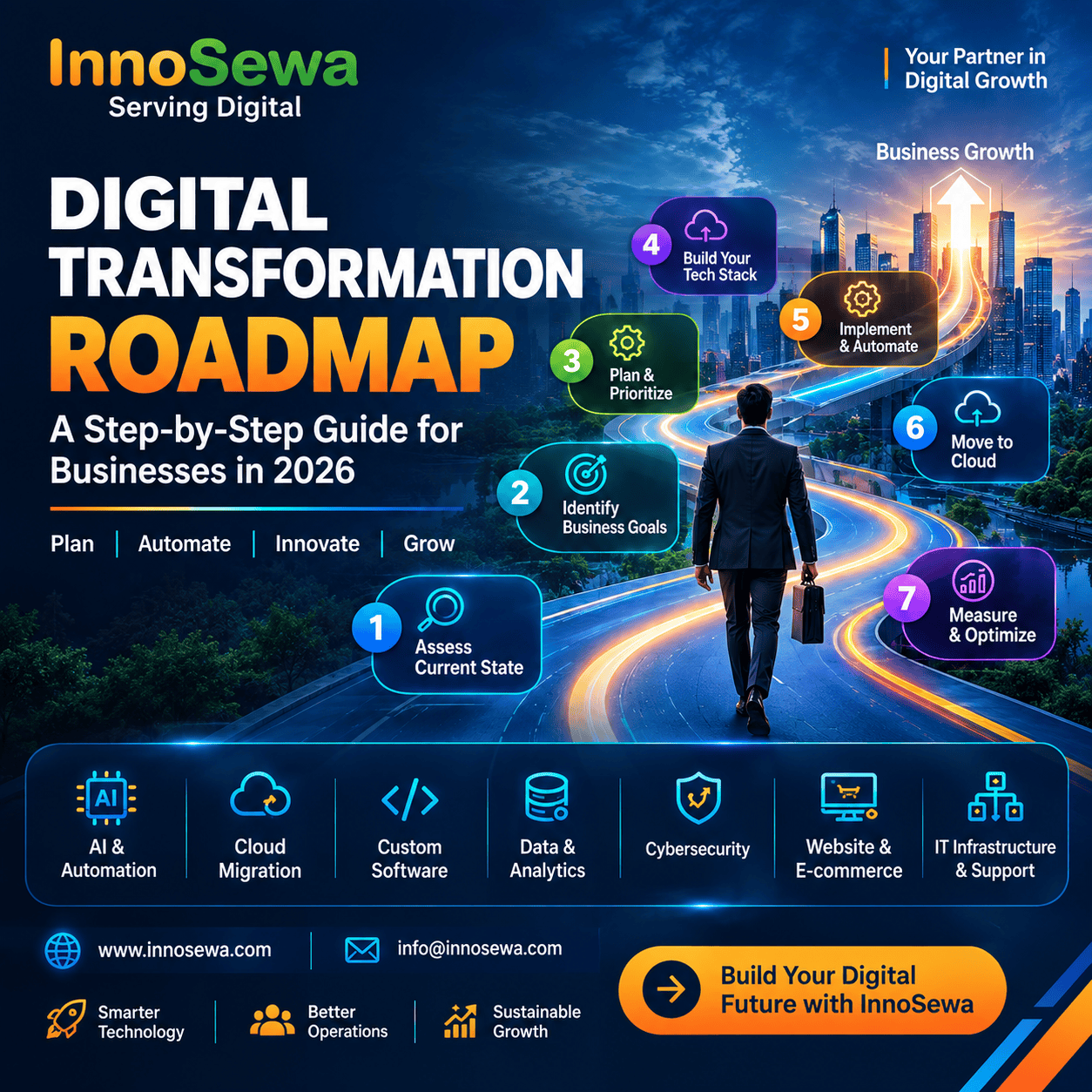
Digital Transformation Roadmap: A Step-by-Step Guide for Businesses in 2026
Executive Summary
Digital transformation is no longer simply about moving from paper to software. Modern businesses need connected systems, cloud infrastructure, automation, AI, data analytics, cybersecurity, and digital customer experiences working together.
But many businesses don't know where to start.
A digital transformation roadmap provides a structured path for identifying technology gaps, prioritizing investments, implementing new systems, and measuring business results.
In this guide, we'll explain the key stages of building a practical digital transformation roadmap for SMEs and enterprises.
What Is a Digital Transformation Roadmap?
A digital transformation roadmap is a strategic plan that defines how a business will use technology to improve its operations, customer experience, productivity, and growth.
It typically covers:
- Business process automation
- AI and intelligent automation
- Cloud migration
- Custom software
- ERP and CRM systems
- Data analytics
- Cybersecurity
- Website and e-commerce modernization
- IT infrastructure
- Digital customer experience
The goal isn't to adopt every new technology. The goal is to identify the right technology for specific business problems.
Why Businesses Need a Digital Transformation Strategy
Many organizations operate with disconnected systems.
For example:
Website → Excel → Email → CRM → Accounting Software → Manual Reporting
Employees spend valuable time moving information between systems.
A digital transformation strategy can create a more connected environment:
Customer → Website/App → CRM → Automation → ERP → Analytics → Management Dashboard
This reduces manual work and gives management better visibility into business operations.
InnoSewa works with businesses on digital transformation and automation initiatives, including software development, application services, data analytics, infrastructure, and help desk services. (InnoSewa)
7 Steps to Build a Digital Transformation Roadmap
- Assess Your Current Technology
Before investing in new technology, understand what you already have.
Review:
- Website and digital platforms
- Software applications
- CRM and ERP
- Servers and infrastructure
- Cloud usage
- Data storage
- Security
- Manual processes
- Customer communication
- Reporting systems
Identify where employees are spending unnecessary time on repetitive tasks.
Ask:
What is slowing the business down today?
That question should drive your transformation roadmap.
- Identify Business Problems
Don't start with technology.
Start with business problems.
For example:
Business Problem | Potential Digital Solution |
Too many manual enquiries | AI chatbot / AI agent |
Manual lead follow-up | CRM automation |
Outdated software | Custom application |
Expensive infrastructure | Cloud migration |
Poor reporting | Data analytics dashboard |
Repetitive administration | Workflow automation |
Slow website | Website modernization |
Disconnected systems | API integration |
This approach prevents businesses from investing in technology simply because it is trending.
- Prioritize High-Impact Processes
Not every process needs to be transformed simultaneously.
Prioritize projects based on:
Business Impact + Cost + Complexity + Urgency
A useful approach is to divide projects into three categories:
Quick Wins
Projects that can deliver results quickly.
Examples:
- Automated email workflows
- AI customer support
- CRM automation
- Digital forms
- Reporting dashboards
Strategic Projects
Projects requiring more planning.
Examples:
- ERP implementation
- Custom business software
- Cloud migration
- CRM integration
Long-Term Transformation
Large-scale initiatives such as:
- AI-powered operations
- Enterprise automation
- Advanced analytics
- Integrated digital platforms
- Intelligent business processes
- Build Your Digital Technology Stack
A modern digital transformation roadmap may include several technology layers.
Customer Experience
- Website
- E-commerce
- Mobile applications
- Customer portals
- AI customer support
Business Applications
- CRM
- ERP
- HR systems
- Project management
- Accounting
Automation
- Workflow automation
- AI agents
- RPA
- Business process automation
Infrastructure
- Cloud
- Servers
- Backup
- Disaster recovery
- IT support
Data
- Business intelligence
- Analytics
- Dashboards
- Data integration
Security
- Identity management
- Access control
- Backup
- Monitoring
- Cybersecurity
The key is integration. Digital transformation becomes significantly more valuable when these systems can exchange information instead of operating independently.
- Introduce AI and Automation
AI is becoming an important component of modern digital transformation.
Businesses can use AI to automate:
- Customer support
- Lead qualification
- Sales follow-ups
- Document processing
- Data analysis
- Internal help desks
- Email management
- Reporting
- Business workflows
Our previous articles on AI Automation for Small Businesses and AI Agents vs AI Chatbots explain how businesses can begin adopting intelligent automation.
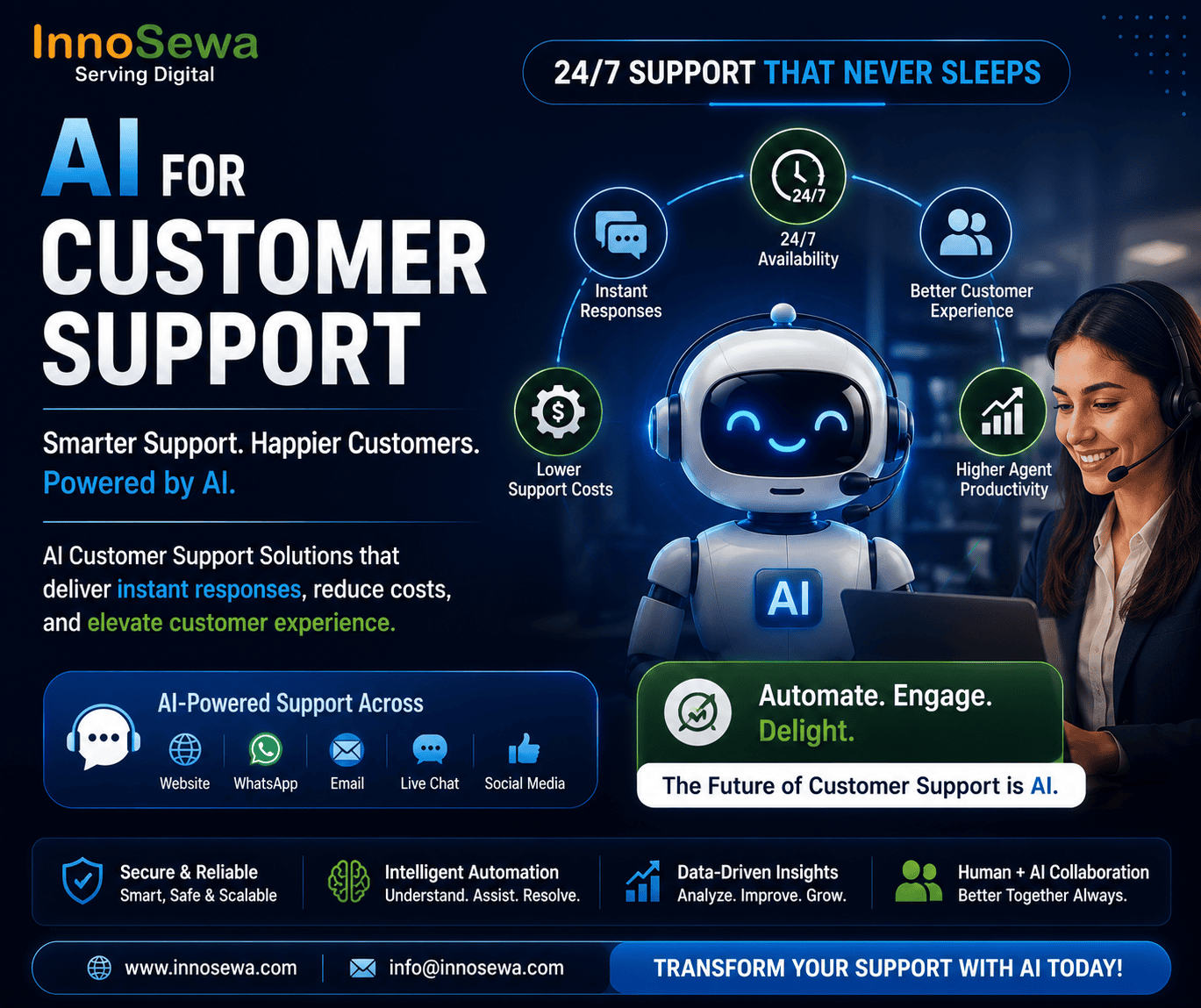
For customer-facing operations, AI customer support can provide 24/7 assistance while escalating complex issues to human employees.
- Modernize Your Cloud & IT Infrastructure
Legacy infrastructure can make transformation difficult.
Cloud migration can help businesses improve:
- Scalability
- Accessibility
- Infrastructure flexibility
- Backup and disaster recovery
- Application deployment
- Operational efficiency
However, cloud migration should be planned carefully rather than treated as a simple server move.
InnoSewa's migration services include cloud migration, SaaS/PaaS migration, application re-engineering, data migration, technology migration, and server migration. (InnoSewa)
- Measure the Results
Digital transformation should produce measurable business outcomes.
Track metrics such as:
Productivity
- Hours saved
- Tasks automated
- Employee productivity
Customer Experience
- Response time
- Customer satisfaction
- Support resolution time
Financial
- Operating costs
- Revenue generated
- Cost per transaction
- Technology ROI
Operations
- Processing time
- Error rate
- System uptime
- Workflow completion time
Don't measure transformation by the number of technologies implemented.
Measure it by the business value created.
Digital Transformation Roadmap Example
A practical 12-month roadmap could look like this:
Phase | Timeline | Focus |
Assessment | Month 1 | Technology & process audit |
Planning | Month 2 | Strategy & priorities |
Quick Wins | Months 3–4 | Automation & digital workflows |
Integration | Months 5–7 | CRM, ERP & application integration |
Cloud & Infrastructure | Months 6–8 | Migration & modernization |
AI Adoption | Months 8–10 | AI agents & intelligent automation |
Analytics | Months 9–11 | Dashboards & business intelligence |
Optimization | Months 11–12 | Performance & ROI review |
The actual timeline should depend on the organization's size, existing technology, budget, and transformation goals.
Common Digital Transformation Mistakes
- Adopting Technology Without a Strategy
Buying software doesn't automatically create digital transformation.
- Trying to Transform Everything at Once
Large transformation projects should be divided into manageable phases.
- Ignoring Employees
Technology adoption requires employee training and change management.
- Creating Disconnected Systems
A collection of separate applications can create more complexity rather than less.
- Ignoring Cybersecurity
New digital systems increase the importance of identity management, access control, monitoring, backup, and security.
- Not Measuring ROI
Every major transformation initiative should have measurable objectives.
Digital Transformation + AI: What’s Next?
The next stage of digital transformation is moving from digitized processes to intelligent processes.
Instead of simply storing information digitally, businesses can use AI to:
Understand → Analyze → Decide → Automate → Improve
For example, a traditional CRM stores customer information.
An AI-powered CRM ecosystem could:
- Identify a new lead.
- Analyze the lead.
- Determine its priority.
- Send a personalized response.
- Schedule a meeting.
- Update the CRM.
- Notify the sales team.
- Analyze the outcome.
This combination of AI + automation + integrated business systems is becoming an important direction for modern digital transformation.
Features to Look for in an AI Customer Support Solution
When choosing a solution, consider whether it offers:
- Natural language understanding (NLP)
- Integration with CRM and helpdesk software
- Multi-channel support (website, WhatsApp, email, social media)
- Ticket management
- Analytics and reporting
- Knowledge base integration
- Human agent handoff
- Custom workflow automation
- Data security and access controls
How InnoSewa Can Help
Digital transformation doesn't have to mean replacing your entire technology stack.
InnoSewa takes a practical approach by combining digital transformation, software development, automation, cloud migration, IT infrastructure, and analytics based on business requirements. (InnoSewa)
Our capabilities include:
- Digital Transformation Consulting
- Custom Software Development
- ERP & CRM Solutions
- AI & Workflow Automation
- Website & E-commerce Development
- Cloud Migration
- Server Management
- Data Analytics
- Application Services
- IT Infrastructure
- Help Desk Services
Explore InnoSewa's Digital Transformation & IT Solutions
For businesses considering cloud or legacy-system modernization, you can also explore InnoSewa Migration Services.
FAQ's
It is a strategic plan that defines how an organization will use digital technologies to improve operations, customer experience, productivity, and business growth.
It depends on the organization’s size and objectives. Smaller initiatives may take weeks or months, while enterprise-wide transformation can take several years.
No. AI is an important modern technology, but digital transformation can also involve cloud computing, software modernization, automation, data analytics, cybersecurity, and system integration.
Yes. SMEs can start with focused projects such as CRM automation, AI customer support, cloud migration, workflow automation, or website modernization rather than attempting a large-scale transformation immediately.
Start with a technology and business-process assessment. Identify the biggest operational bottlenecks and prioritize transformation projects according to business impact and ROI.
Conclusion
A successful digital transformation roadmap isn't about adopting the most technology. It's about using the right technology to solve the right business problems.
Start with your current processes, identify inefficiencies, prioritize high-impact opportunities, modernize infrastructure, introduce automation and AI where appropriate, integrate your systems, and continuously measure the results.
For businesses beginning their transformation journey in 2026, the strongest approach is increasingly AI + automation + cloud + integrated business systems + data-driven decision-making.
If you're planning your organization's next digital transformation initiative, book a free consultation with InnoSewa to discuss your requirements and create a practical technology roadmap. InnoSewa currently offers a no-obligation consultation for businesses evaluating digital and IT solutions. (InnoSewa)
AI Automation is no longer a future technology—it is a business necessity in 2026. Companies that implement AI-driven workflows today are gaining a significant competitive advantage through improved efficiency, lower operational costs, better customer experiences, and faster growth.
Whether you want to automate customer support, streamline business processes, improve lead generation, or accelerate digital transformation, AI can deliver measurable results.
Ready to explore AI automation for your business?
Contact InnoSewa today and discover how intelligent automation can transform your operations and drive sustainable growth.
https://innosewa.com/contact-us/
Why Partner with InnoSewa?
At InnoSewa, we don’t just build software; we design enterprise-grade ecosystems. Whether you are in compliance, finance, or infrastructure management, we specialize in taking complex, data-heavy processes and turning them into elegant, automated solutions.
Is your business ready for its own digital transformation?
Visit us at www.innosewa.com to start your journey today.
How InnoSewa Helps Businesses Optimise Costs Globally
Ready to build a future-ready e-commerce system?
👉 Contact InnoSewa today
👉 Get a free consultation and strategy roadmap